Tuesday, June 5, 2012

life is to short...


Life is too short.
   “Life is too short to be living somebody else´s dream” Hugh Hefner
      “Life is too short to be vengeful or malicious.” Phillips Brooks
Life is too short.
From what I have learned this year, the quotes above are clichés. But a cliché is given the name of a cliché because it has been over used.  Some thing is used a lot because people like it or identify with it. Surely, “life is too short…” is a line that people identify with it. 

When describing Melania, Marco Polo talks a city filled with dialogue. Non-stop dialogue. When people die, the dialogue does not die with them. Instead, others replace their roles. It happens on a regular basis. So the dialogue is more important than the people. He ends the description of the city with the following line:
   “even if the lives of Melania´s inhabitants are too short for them to realize.” (pg. 22)

After reading that I truly understood the meaning behind the cliché. I have always heard people saying, especially older people, that are “wiser” because they have lived more.

I mean, how can life be short if many people live around 70 to 80 years? There are 365 days in a year, 24 hours in a day, 60 minutes in an hour, and so on. If we make the calculations, we would end up with an enormous amount of seconds. Still after reading how fast the people of Melania are forgotten, or how easy it is for them to be of no importance I understood the cliché: “life is too short.”

In numbers, life is long but (to use another cliché) it can pass “in a blink of an eye,” because many say that “time flies when you are having fun”. (Ok. Enough clichés)

It does not matter how short or long your life is, but you only have one and you have to make it count. My sister graduated form school this year and will be leaving in less than two months. Two years ago, I could not imagine that happening, but it will. Before I know, I will be the one leaving to study, and every second that passes, I have to make them count, because if not, I will be replaced just like Melania´s inhabitants.
Profits and Money


Marco Polo describes Olivia as a “city rich in products and in profits” (16) A city filled with fine palaces, and a lot of ornaments but at the same time it is covered by dark materials and grease. The cultural aspects are somewhat similar. It is known to be a calm city, but occasionally some one crack a laugh and jokes and sarcasm fill the city. 
On the cultural and physical aspects, there seems to be a clash, but it appears to be as if the inhabitants were trying to maintain a balance.
Marco Polo starts by describing a city which one imagines being wonderful. For the people who desire money and wealth, that is the place to go, but then that imaged is ruined because it is “shrouded in a cloud of soot and grease tat sticks to the house…” (pg 16) Who would want to live in a place like that?

Yet, you see it happening very often. Now-a-days people would do anything for money. The culture has evolved into one that revolves around wealth and power. Today, in order to be important, you have to have money or do some thing extraordinary. But to do some thing extraordinary, you have to have money, so it all goes back to wealth.  It is vital to mention, that money is not only a desire. It has become a need. Commodities are something every body would want to have, but that is not what money means. People with money to spare, do have commodities, but the majority of the people, need the money simply to survive.

I don´t know where this culture is going to take us but maybe it would be good to follow Khans advice: “my empire has grown too far towards the outside. It is time for it to grow within itself.” (pg.19) Money will always be a necessity in life, but it does not have to be the most important one.  Just like in Olivia, there should be occasional jokes that would break the importance of money and let other things come in. 

Sunday, June 3, 2012

Life´s Things


The table of contents of the book is different from all. The way the chapters are arranged suggest that there are many ways to read the book. On can read the different cities and ____ (for example Cities and Memory) in order or by blocks, starting fro the end. I choose to read the book in page order.

Since I already new that the empire symbolized the life of the reader, it seemed obvious that the cities meant something, related to life.  An option could be the events that happen in one´s life or the essential things to one life. I kept on reader with this in mind and connected that with the description of each city.  

The following descriptions have been introduced: memory, desire signs, thin, trading, and eyes. These words follow the word “city” or go before it, in the name of each chapter.

Anastasia is the second city of “Cities and Desire.” Even though Marco Polo says that the description awakens desire, truly “you believe you are enjoying Anastasia wholly when you are only it´s slave.” (Pg. 12) I would say that this would be a good definition of many events in live. You may believe that you are enjoying every thing you do in life, but truly you do not have a choice. Take school or any form of education as an example.  You may have fun at school, and like being with your friends and even learning, but you don´t have the option of choosing whether you want it or not. You have to go to school, not only because your parents force you to, but also because, with out an education it is very unlikely to succeed in life.

The most obvious of all is “cities and memory.” Life is based on memories and past events.  Human beings mostly act and make decisions based of the events of the past. When I cook a cake for the first time, and it burns, the next time I cook it, I would remember this time and put the oven less hot.
One of the cities that confused me was “Thin Cities.” I could not think of something essential that could be represented by the word thin, but after reading more “Thin cities,” I noticed a trend in the description of these. In all, Marco Polo mentioned the water, and the importance to the city.  Valdrada is on of these and actually there are two Valdrada. Since the city was built next to a body of water, every thing is reflected upon it, creating the second Valdrada.  Since all had to do with water, this could only mean that “Thin Cities” are responsible for symbolizing the need of water. With out water, nothing of earth would survive.


The Irony of Calvino


In class, we read the fifth page of Italo Calvino´s Invisible Cities and concluded the following:

  • ·      Kublain Khan stands for power
  • ·      Marco Polo stands for knowledge
  • ·      Khan´s empire stands for the life of each individual


Going further on, we concluded that the reader is Khan and the writer is Marco Polo. We are the readers, I am khan, and as I am reading, the writer Marco Polo is feading me with knowledge. The knowledge he was recollected through out his expeditions through Khan´s Empire.

As I continued reading the book, I noticed that there was it did not have a story plot. Every chapter accounts for a new city that Marco Polo is describing. The methods of description are very similar to Hemingway´s. He states the facts of the cities, what he saw, but he leaves his feelings aside. He tells Khan what is special about each city, but leaves him (and us) to feel what we want about the cities.

All of the descriptions of the cities got me thinking about the title of the book. Invisible Cities. Can this be possible? The title is ironic. A city is composed of elements: roads, building, forests, cars, schools, houses, ext. All of these things can be evoked by the 5 senses; therefore they are not invisible.  In page 10, Marco Polo defines what cities consists of “of relationships between the measurements of its spaces and the events of it´s past.”

Another irony present in the book is the empire. It is huge, made up of many cities and all is under the power of one man: Kahn. If one is the ruler of something he or she should know everything that has to do with it. Yet, Kahn does not even know all the languages: “the emperor  is he who is foreigner to each of his subjects…” (page 21) 

Tuesday, May 15, 2012

The Power of the Kind (but not naive)


“Nice guys finish first?” In fact, I believe they do. But the key word in that sentence is guys, because even though Dawkins mentions animals and examples of Prisoner´s Dilemma, that phrase only applies to human beings. Reason being there are many other factors that affect the game. The life of humans is not programmed inside a computer: it is not based on rules.

In the real world, a nice guy is most likely to survive than a nasty person. But the nice guy has to be intelligent enough and not let others fool him. The nice guy would be the one to survive because most people tend to like him, while the nasty guy is hated by most. A nice guy is friendly with another nice guy, but a nasty guy is not friendly with another nasty guy. Also culture, society and religion tend to accept the behavior of the nice guy. The Ten Commandments many have to do with nice and forgiving actions. Few people are going to be nice to a person that treats them bad. Why would I give candy to some one that did not give me candy? But that is were forgiving becomes essential. If deny the candy because it was denied to me then that person most certainly will deny be again in the future. But if I give, regardless if I was denied or not, the other persons perception could change. Most of the human population goes by the strategy “Tit for Tat,” basing their actions upon the actions of others. It is very likely that a “defect-defect” line will form because there are some nasty people, but it takes the kindness and forgiveness of just one to break that line. 

Another very interesting example that Dawkins gave was the “live-and-let-live,” that Germans and British troops applied during some part of the First World War. He mentioned that once “at Christmas British and German troops briefly fraternized and drank together in no-ma´s-land.” (Page 225) This remained me of the movie War Horse, also set in World War One. In the midst of the war, a horse sprinted through no-man´s-land between a British and a German fort. The field was field with a lot of barbed wire and the horse eventually got stuck and could not move. Upon the scene, a British soldier raised a white flag and risked his life to save the horse´s. He got to the horse and could not figure out were to start, and then a German soldier came out to help his “enemy” save the horse. Together they were able to save it, and when the job was done, they even shacked hands. This is a clear example of “nonzero sum game.” Neither of them lost and they even felt like they won something.

To end this, I believe that this shows that even though genes may be selfish, human beings are not. The population may be divided be varied opinions and cultures, but a the end, it takes a random situation to end disputes.


Sunday, May 13, 2012

Genes then Memes


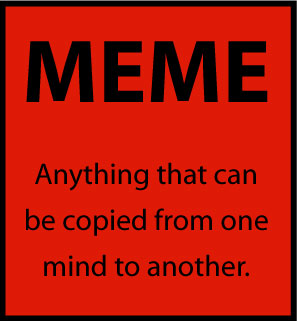
According to Dawkins, genes are replicators. DNA has existed millions of years ago and their function it to reproduce so that they can be passed on to other organisms. This is nature´s way of ensuring the life and survival of the organisms on the planet. Further on in his reading he mentioned another type of replicator that has appeared: the “meme.”  To summarize what he said, meme are the genes of culture. It´s is his way of explaining how one person takes in everything that is around him or her. This is something I strongly agree with. People are born with their unique genetic make-up that builds them up. During the years the traits start to appear and one can see the resemblance the off spring has with the parents that conceived him. As well as physical traits, some personality traits can also be inherited. After the genes comes the memes. Thanks to this replicator, humans are able to learn new languages, play an instrument, and learn a song. Also, the memes are the ones that enables someone to leave their mark on the planet. The whole world will always remember Leonardo Da Vinci for his sculpture “The David,” or Jose Mourihno for winning four major leagues in 4 different countries. This is all part of the human culture that memes replicate and make every body aware. Richard Dawkins also mentions that one-day memes will take over genes, but this is physically impossible. A replicator of culture cannot replace the replicator of life. With put genes, memes would not have work to do; they would not have culture to transmit because not life would exist. Genes will exist forever or until or the organisms become exist, because they are the building blocks of life. 

Sex: Reproduction or Pleasure?


In chapter 10, Dawkins explained the basic behavior of ants of bees that are part of the group of “social insects.” He gave a very thorough explanation of how this community of “social insects” functions. There are two types of insects, like two social classes. The most important is the queen and then there´s the workers. The role of the workers is to keep the community going and to satisfy the queen. (By satisfy I don´t mean like presents or massages, just feed her and keep her alive.) The role of the queen is to live and reproduce herself. One of the most interesting things is the way she reproduces herself. Instead of mating with a male each time she wants to reproduce, she does it only ones and stores the sperm of the mate, to be used further one. In this community of insects, sex is only used for reproduction. That is the main reason why insects and animal mate, with the exception of humans.  Even though the main purpose of sex in humans is also reproduction, many do it for pleasure. This is why condoms, anti-conceptive or many other prevention methods exist. Many happy couples of single people want to have sex in order to reproduce and have a baby but most of the people today, want to have sex in order to entertain themselves. I don´t know it that is a sign of intelligence or stupidity but people could argue both. A stronger believer in the first option would say that humans are more intelligent because they have discovered other things that sex can offer. A believer of the latter can argue and say that it is not an intelligent thing to do because thanks to unprotected sex and the wild imagination of humans many people have died. To make myself clear, through sex one can get many diseases that can end up killing a person. If the companion is not a known person, the stakes of this occurring are very high. Is it worth it risking one´s health for the “pleasure and entertainment” of one night?